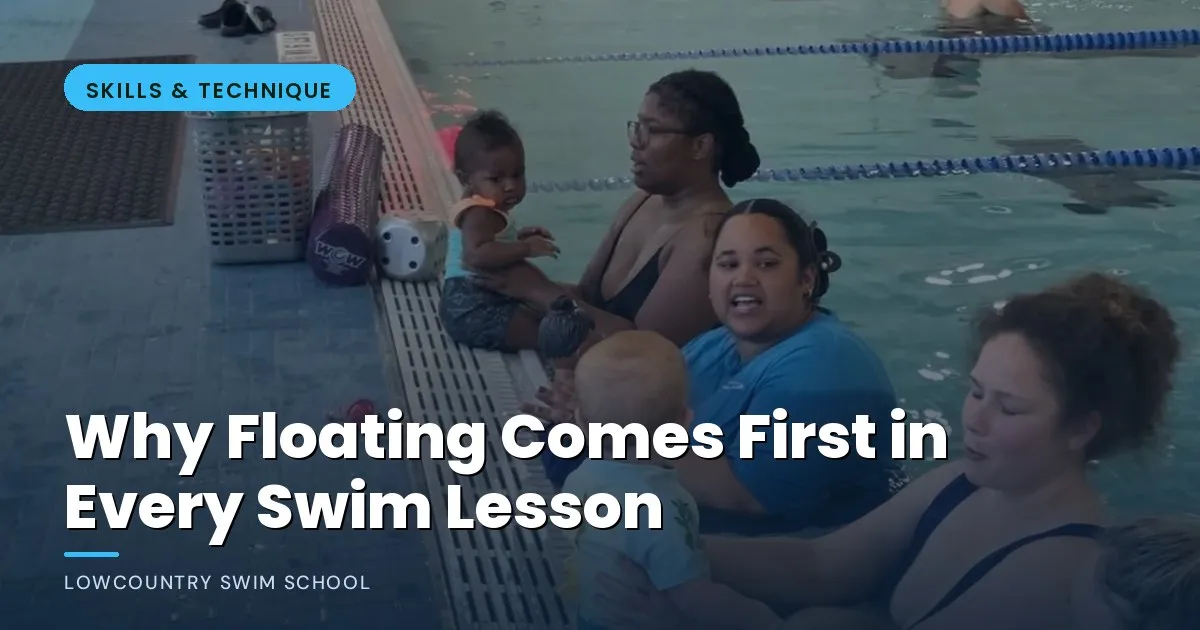
Why Floating Comes First in Every Swim Lesson
Why Floating Comes First in Every Swim Lesson
Parents often want to see strokes. Instructors want to see a calm back float, because that is the skill that actually saves lives.
Start at Level 1 →If you watch a beginner swim lesson hoping to see your child swimming, the first few weeks can feel slow. There is a lot of floating, a lot of rolling over, a lot of getting comfortable, and not much that looks like the freestyle you were picturing.
That is deliberate, and it is the most important design decision in the whole program. Floating is not a warm up for the real skills. It is the real skill, and everything else is built on top of it.
A floating swimmer is a breathing swimmer
The thing that makes water dangerous is not depth or distance. It is being unable to breathe. A child who can roll onto their back and float has solved that problem, and has bought themselves time for help to arrive.
What floating actually teaches
There is far more happening in a back float than it looks like from the poolside.
Breath control
Full lungs float. Learning to hold a relaxed breath and release it slowly is the mechanical basis of every float and every stroke that follows.
Staying calm
Panic makes a body sink by tensing it and emptying the lungs. Floating is the first place a child learns that calm is a physical technique, not just a feeling.
Body position
A long, level body is what moves efficiently through water. Floating is where that shape is learned, before any arms or legs are added.
Rolling over
Getting from face down to face up is the actual life saving movement, and it takes real practice to make automatic.
Trusting the water
Learning that water holds you up if you let it is a genuine shift for most children, and it changes everything afterwards.
A fallback position
When a swimmer gets tired, disoriented or overwhelmed later on, back floating is the thing they return to.
Why strokes without floating do not hold up
A child can be taught to move their arms in a recognisable freestyle fairly quickly. It looks like progress and parents love it. The problem appears the moment that child gets tired, takes on water, or ends up somewhere unexpected, because thrashing arms without a fallback position is exactly the drowning response.
Skills built in the right order hold up under stress. Skills built for appearance do not. That is why our Level 1 is explicitly water safety and an introduction to floating, and why strokes, breathing and more water safety come at the next stage rather than the first.
How floating is taught
It is a progression, not a single lesson, and it moves at the pace of the individual swimmer.
Comfort and support
The instructor supports the swimmer while they get used to the sensation of the water holding them and the feeling of water around their ears.
Reducing support
Support is gradually withdrawn as the swimmer holds position independently, often without them noticing it happening.
Holding it independently
The swimmer maintains a relaxed back float alone, breathing normally, for progressively longer.
Rolling to it
The final piece is getting into a float from face down or from movement, which is what makes the skill useful in a real situation.
How long it takes
Every child is different, and floating is one of the skills with the widest range. Some children relax into it in a couple of sessions. Others need considerably longer, particularly if they are anxious about water in their ears or having their face near the surface. Both are completely normal.
What consistently helps is regular lessons rather than intensive bursts, and a small class where the instructor can stay close. Our group classes have a maximum of three swimmers, semi private lessons have two, and private lessons are one on one, which is often the fastest route for a child who needs more reassurance.
Frequently asked questions
Why does my child spend so long floating instead of swimming?
How long does it take a child to learn to float?
Can my child skip floating if they already swim a bit?
Why does floating help in an emergency?
What level does floating belong to?
Related reading
Start where it matters
Water safety and floating first, strokes after. That order is what makes a swimmer safe as well as capable.
Register for swim lessons →