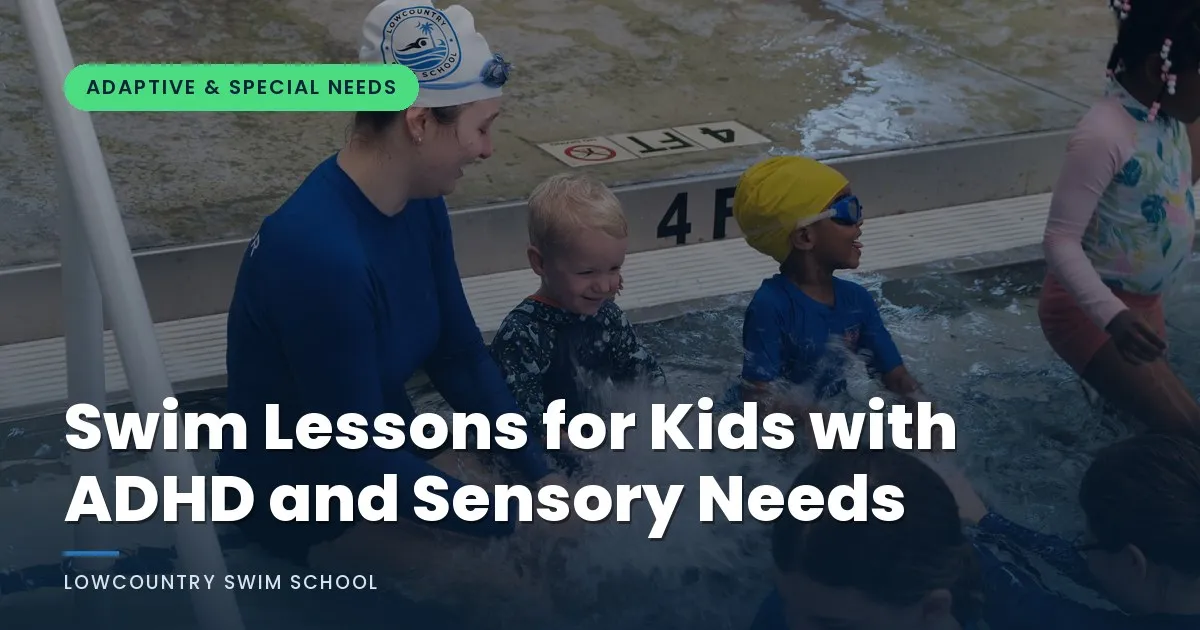
Swim Lessons for Kids with ADHD and Sensory Needs
Swim Lessons for Kids with ADHD and Sensory Needs
A busy pool is a lot of input at once. For some children the answer is not more effort, it is a quieter setting and full attention.
Ask about adaptive lessons →Swimming has a great deal to offer children with ADHD or sensory sensitivities. The water provides deep, even pressure that many children find genuinely calming, the activity is physically demanding in a way that helps regulate energy, and the skills build in clear, achievable steps.
The complication is usually the environment rather than the swimming. A busy pool is loud, echoing, bright, cold and full of unpredictable movement, and for some children that combination uses up all their capacity before a single instruction has been given.
Adaptive lessons are always private
Our adaptive lessons are always private, so your swimmer gets full, undistracted attention in a calm setting. That is not an upgrade, it is the format, because it is what actually works for the children who need it.
Why the water often helps
Swimming has qualities that suit these children specifically, once the environment is right.
Even pressure
Water applies constant, predictable pressure across the whole body, which many children with sensory sensitivities find regulating.
Physical output
Swimming is genuinely demanding, and that sustained physical effort helps a lot of children with energy regulation.
Clear structure
A leveled progression gives concrete, visible steps rather than an open ended activity, which suits children who need to see the shape of a task.
Immediate feedback
The water responds instantly to what you do, which makes cause and effect obvious without needing verbal explanation.
Real achievement
Swimming produces genuine, undeniable milestones. For a child who struggles in other structured settings, that matters a great deal.
A safety skill that counts
Impulsivity around water is a real risk factor, which makes competence in the water especially valuable for some children.
What we adapt
The single biggest adaptation is the setting itself. A private lesson in a calm environment removes most of the sensory load that makes group classes difficult: fewer people, less noise, no waiting, no watching other children take turns.
Pace is the second. A private lesson can spend an entire session on one thing, or move quickly through several, depending on what the swimmer needs that day rather than what a plan says. There is no group to hold up and no comparison happening.
Communication is the third. Instructions can be shortened, demonstrated rather than explained, repeated without impatience, or delivered in whatever way works for that child. Instructors also learn what a particular swimmer's signs of overload look like, which is only possible one on one.
How to set it up well
A few things that make a real difference before the first lesson.
Tell us what works
Before the first session, share what helps your child and what does not. Specific detail about triggers, communication style and warning signs is far more useful than a diagnosis.
Visit the pool first
Seeing the space when nothing is expected removes a lot of the unknown. Many children do much better on lesson one having already been in the building.
Plan the timing carefully
Not after a demanding day, not when hungry or tired. For these swimmers in particular, timing changes the outcome more than technique does.
Expect uneven weeks
Some sessions will go much better than others, and that is not a sign the approach is wrong. Progress here is measured over months, not weeks.
Moving toward a group later
For some swimmers, private adaptive lessons are the right long term format and there is no reason to change. For others, the goal is building enough comfort and skill to join a group class later, and that is a perfectly realistic path.
When that time comes, our group classes cap at three swimmers and semi private lessons take two, so even the group options are small and relatively calm compared with most swim schools. That makes the step up considerably less abrupt.
Frequently asked questions
Are your adaptive lessons private?
Can children with ADHD learn to swim in a group class?
Why does swimming help children with sensory needs?
What should I tell the instructor before the first lesson?
Can my child move to a group class later?
Related reading
A calm setting and full attention
Adaptive lessons are always private, always patient, and always built around the swimmer in front of us.
Register for swim lessons →