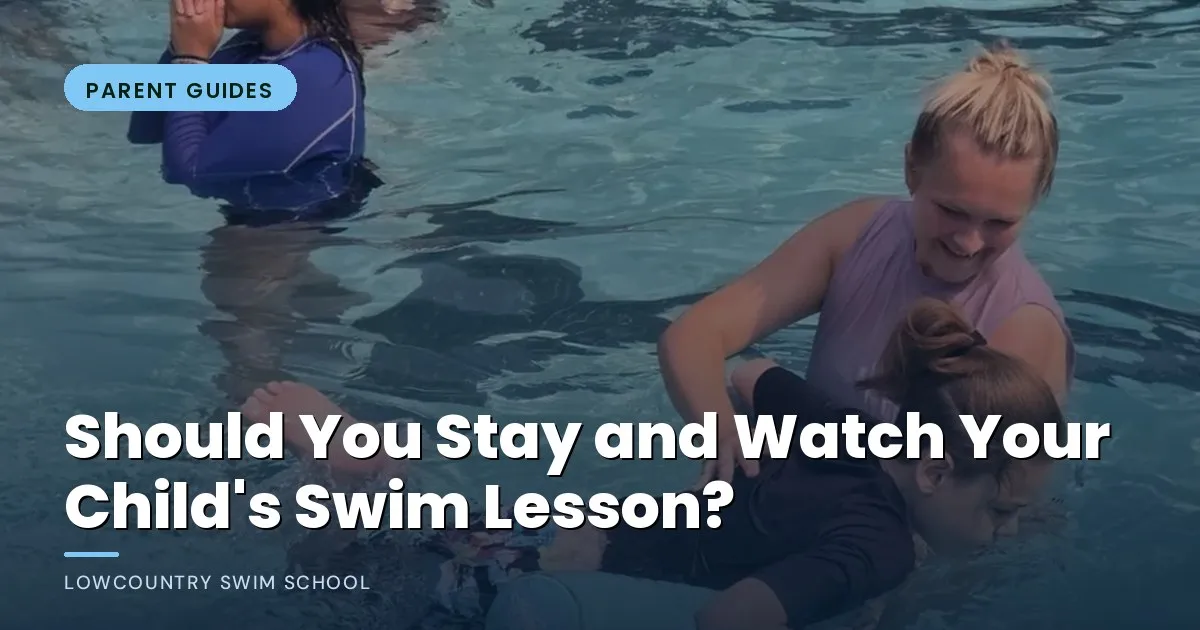
Should You Stay and Watch Your Child's Swim Lesson?
Should You Stay and Watch Your Child's Swim Lesson?
Some children swim better when you are watching. Some swim better when you are not. Here is how to tell which one you have.
Book a lesson →It is one of the most common questions parents ask, and the honest answer is that it depends entirely on the child. There is no universal rule, and instructors will tell you they have seen it go both ways many times.
What is worth understanding is why it goes each way, because that makes it much easier to work out what your own child needs, and to change your approach if the first one is not working.
Look at what happens when you move
If your child checks where you are every few seconds and their swimming stops when they cannot see you, your presence has become part of the lesson. If they forget you exist, your presence is neutral and you can relax.
When watching helps
For some children, particularly early on, having you there does real work.
A new or anxious swimmer
For a first lesson or a nervous child, seeing you nearby is often what makes getting in the water possible at all.
Younger children
Very young swimmers frequently need visual reassurance that their person is still there, and removing it too early is counterproductive.
Learning the language
Watching helps you understand what the instructor is working on, so you can support it rather than accidentally contradict it.
Seeing real progress
Progress in swimming is often invisible from outside unless you know what to look for. Watching a few lessons calibrates your expectations usefully.
Building trust in a new instructor
For the first few sessions with someone new, watching lets you see how they work and how your child responds.
Practical handling
Knowing the routine, where things happen and how the pool works makes every subsequent visit easier.
When stepping back helps more
The most common pattern instructors describe is a child who performs for their parent rather than working with the instructor. They look up constantly, wait for reactions, and stop when the audience is not paying attention. That is a completely normal thing for a child to do and it does slow progress.
There is a second version, where a child behaves quite differently with a parent present, often more reluctantly or more dramatically. Many parents are surprised to hear that their child got straight in and worked hard the week they were running late and arrived at the end.
If either sounds familiar, try moving further back rather than leaving entirely. Sitting where your child can find you if they look but is not in your direct eyeline is often enough to break the pattern without removing the reassurance.
How to be a useful audience
If you are watching, a few things make it more helpful.
- Watch rather than coach. Instructions shouted from the side, however well meant, compete with the instructor.
- Keep your reactions steady. Big responses to every attempt turn the lesson into a performance.
- Save the debrief for afterwards, and lead with what they enjoyed rather than what they achieved.
- Avoid comparing your child to others in the class, out loud or in your own head.
- If something concerns you, raise it with the instructor after the lesson rather than during it.
Talk to the instructor
Instructors see this pattern constantly and generally have a clear read on it within a couple of sessions. Asking directly whether your child works better with or without you watching is a completely normal question and you will usually get a straight answer.
Our classes are small by design, with a maximum of three swimmers in a group class, two in a semi private and one on one in a private lesson, so instructors know each swimmer well enough to give you a real answer rather than a generic one.
Frequently asked questions
Should parents watch swim lessons?
My child behaves worse when I watch. Is that normal?
Should I give my child instructions from the side?
What should I say after a lesson?
Will my child be upset if I am not watching?
Related reading
Small classes, close attention
Group classes of three at most, semi private of two, or one on one private lessons. Every instructor knows every swimmer.
Register for swim lessons →