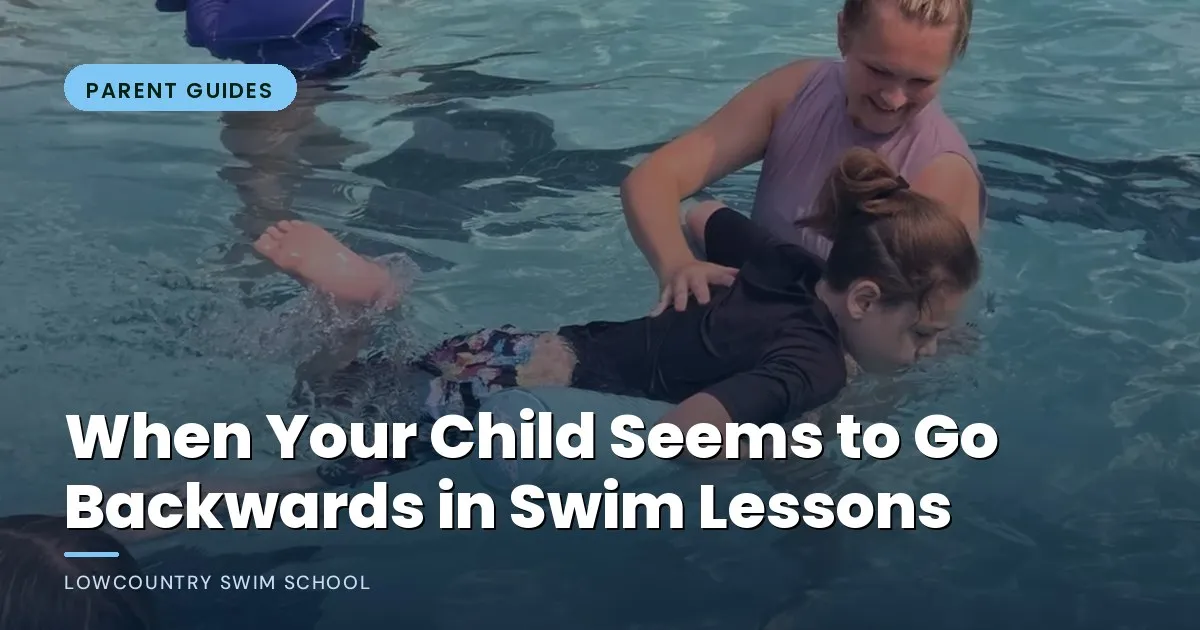
When Your Child Seems to Go Backwards in Swim Lessons
When Your Child Seems to Go Backwards in Swim Lessons
They could do it last month and now they will not even get in. This happens to a lot of swimmers and it almost always passes.
Talk to an instructor →One of the most disheartening moments for a parent is watching a child who was doing well suddenly stop. They will not put their face in the water any more. They cling to the wall. A skill they had last month has apparently vanished.
It is worth saying clearly: this is extremely common, it happens to swimmers at every level, and in the great majority of cases it resolves. Understanding why it happens makes it much easier to respond well rather than reacting in a way that prolongs it.
Progress in swimming is a staircase, not a ramp
Children consolidate skills in bursts, with flat periods and dips in between. A dip is usually a sign that something underneath is being rebuilt rather than a sign that the learning has failed.
The usual causes
Most regression traces back to something on this list, and most of them have nothing to do with swimming.
A scary moment
A slip, a mouthful of water, going under unexpectedly, or watching another child struggle. Often the parent never even saw it happen.
A break in lessons
A holiday, illness or a few missed weeks. Skills fade faster than parents expect, particularly in younger swimmers.
A harder new skill
Moving up a level often means temporarily looking worse, because the swimmer is now doing something genuinely difficult.
Life outside the pool
A new sibling, starting school, a house move or poor sleep will show up in the pool before anywhere else.
Cold or tiredness
A cold pool or a lesson at a bad time of day makes everything harder and can look exactly like fear.
Developmental stages
Some age ranges bring a general wave of caution about all sorts of things, and swimming is often where it lands.
What actually helps
The instinct is to push through. That is usually the wrong move.
Keep going to lessons
Stopping is the one response that reliably makes it worse. Even a lesson spent sitting on the step is better than a missed one.
Take the pressure off
Lower the expectation for a few weeks. Success is getting in and being cheerful, not achieving the skill they had before.
Ask what changed
Talk to the instructor, and gently to your child. Frequently there is a specific incident nobody mentioned at the time.
Rebuild from comfort
Instructors will usually drop back to something the swimmer finds easy and enjoyable, then build forward from there.
What to avoid
These are the responses that reliably extend a regression.
- Pulling your child out of lessons until they feel better about it. The confidence comes back through exposure, not away from it.
- Expressing frustration or disappointment, which adds a fear of letting you down on top of the original problem.
- Comparing them to where they were, to a sibling, or to another child in the class.
- Forcing the specific skill they are avoiding, which usually turns a temporary wobble into a lasting association.
- Assuming it means the instructor or the program is wrong. Sometimes it does, but far less often than it feels like.
When to change something
If a regression lasts many weeks without any movement, or if your child is genuinely distressed at every lesson rather than just reluctant, it is reasonable to change the format rather than wait longer.
Moving to a private lesson often helps, because one instructor with one swimmer can go entirely at that child's pace with no sense of holding a group up. Semi private lessons, with two swimmers, are a middle option that some children find less exposing than one on one.
It is also worth a straightforward conversation with the instructor about whether a different approach or a different instructor might suit your child better. Good instructors take that question well.
Frequently asked questions
Why has my child suddenly gone backwards in swimming?
Should I stop lessons if my child is struggling?
How long does regression usually last?
Would private lessons help?
Is it my fault for missing lessons over the holidays?
Related reading
A wobble is not a setback
Patient certified instructors and small classes, with a progression that can slow down and rebuild when your swimmer needs it to.
Register for swim lessons →